Garment 2
[ The Clutching Grip ]


I made a basic syringe pump prototype, controlled with a stepper motor. Once I had control of the motor I was able to set it to speed up and slow down as it reached the end of the pump track. I also added emergency stops as a back up.
The syringe I used was too small and didn't add enough air into the pockets to make much of a difference to them. The motor was also very noisy, heavy and bulky. This would not be practical to duplicate and implement into my garment.

I made these pneumatic bending actuators based on designs from the Soft Robotics Toolkit. I had a lot of issues with the mould and taking the silicone out of it which made a lot of holes. I tried repairing them to make them airtight. The first one had the most damage and I was never able to inflate it properly.
The second one had the most changes to the original design and this worked a lot better. I was able to inflate it and bend it well. This style of actuator was a good starting point to understand how inflation can make movement, but it wasn't really suitable for what I was trying to achieve. I also needed a really big syringe to inflate these fairly small designs, which highlights how unsuitable they are for being the actuation method.
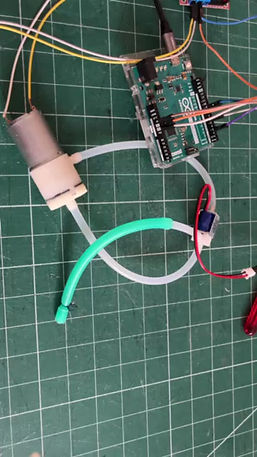
I changed to a vacuum pump powered with a driver. After an initial test with just the pump, I added a valve so that I could control the inflate, hold and deflate more effectively.
To prevent the pump from inflating the tube too much, I started at low power for a very short period of time. This hardly had any inflating power, but I could hear the valve click and see the pump twitch when activated, so I knew it was working.

I researched more about the pump and driver I was using. I eventually discovered I needed to remove a breaker from the driver to get it to reach full power. Once I had done this, it was pumping at full power. I was able to get the tube to inflate and it was easy to update the code timings to get the tube to inflate fully. I was controlling the deflaiton with the pump and the valve, but I eventually realised I could get a good deflation with just the valve so I removed the pump controlled deflation.
I tried adding a second pump to the driver; this made the power drop significantly. I researched for alternative wiring options and found I could use the exact same setup as I had for the valves with a MOSFET.

I added a pressure sensor to the set up so that I could easily activate the movement. I had initially intended to use the pressure sensors to control the direction of the tentacle. However, following my crit, it was decided that I should 'fake' some of the tech elements as this would give me more time to focus on making the garments and on making a film. So I repurposed the sensors as a switch.

In order to test the way the tentacle could move, I tied three tubes together and inflated only one of the tubes. This was a very crude way of seeing how the tentacle would bend if it had three channels. I also tested a version that had three tubes stuck together with silicone. Both versions bent in a similar and in the way I was expecting. This test also highlighted the difference in the silicones I was using. The Ecoflex 30 stretched and inflated a lot more with less air from the pump which would be ideal for the final tentacle design.

I designed a tentacle with three channels for inflation. The aim was to get the tentacle to bend in three directions. There were some imperfections in the casting process which meant parts were thinner and weaker than others. I repaired them by pouring silicone over the top, but there were still weaker and uneven patches.
This test was very successful with the tentacle flopping from side to side. It worked best if elevated off a table to show the full bending. In the testbed, people were really interested in how it felt and wanted to squeeze it. This was interesting as it looked very gross and wet. I also thought the imperfections were quite effective, but I decided to try and fix them as best I could in future iterations to get a better control over the movement.

I made 3 more version of the tentacles. I decided to have only one channel, in part to reduce the number of pumps and valves I would need, but also because I wanted the tentacles to wrap and stretch to have a point of difference to the motorised tentacle. These versions mainly inflated at the top and not further down meaning that they didn’t bend as well. I think the errors in the first version are what made it bend so well and now that I had a more accurate mould I wasn’t getting the uneven thickness.

I thought that adding more ribbing to the inner top would help to reduce inflation at the top and spread it down the whole way. I tested by wrapping elastic around the top. This worked well and it started to inflate lower down. Eventually the elastic popped off at the top the air rushed there. But this was promising for the new design.

I designed two new inners for this mould; one with vertical ribbing at the top and one with lots of horizontal ribbing at the top. This worked really well to spread the inflation out and I got a really good bend on the tentacle. I decided I would combine the two styles for the final design.

I had to increase the size of the tentacle quite a lot to make it proportional to the size the body needed to be and to fit on a human body. This meant I needed a lot more air to inflate the tentacle than the smaller designs. I also had a similar issue to the first iterations where the inflation pooled too much at the top. This did reach out and grow a lot bigger which worked really well, but I wanted to try and increase the bend.

It was expensive and time consuming to keep printing new moulds, so I decided to try and add paper to the inside base and top to spread the inflation. This was really hard to do. The base paper seemed to work well and looked effective with a slight red tint being visible from the bottom, but the top didn’t work very well and looked weird. It also didn’t seal properly around the paper at the top so I had to repair it a lot.
When I inflated it the first time it worked for a second and then it burst. I decided that this wasn’t going to be viable to replicate as it was too unpredictable. I did however make one more with paper just on the bottom. This slightly improved the inflation from the first version, but at this stage I decided to redesign the mould.
Luckily the inner mould was in two pieces that snapped together, so I was able to just redesign the top part. I removed the vertical ribs, made it thinner and added lots more horizontal ribbing. This worked well and I got growth and bend from this version.

I finished wiring all of the pumps (and the motors) into the PCB I had designed. This was nerve wracking, because there was only so much I could do if I had any issues. I did have some grounding problems, but I fixed these by adding ground wires to the copper plated screw holes I had included. I had luckily left a lot of space for adding extra things and more MOSFETs than I needed so there was lots of space for positioning things. I also added the touch sensors and eventually the ESP32.

I put all of the tentacles into the body and I was really happy with how it looked. I liked that I had different styles of inflation with 3 bending like elbows and 2 reaching out more. I would have liked to have different coding to reflect this, but this was very complicated to do and I was worried I would burst the tentacles testing lots of code. I decided to keep it as it was and I could make alterations to the code in the future when I had more time and resources.

I simultaneously created a spine-like tentacle made of 3D printed parts. Each 'vertebra' is connected with a wire that attaches to a servo motor. The motor then turns pulling or pushing the wire, causing the tentacle to bend.
The initial movement is really effective, however, the wire isn't strong enough to push the tentacle back into place before bending the other way. It would become stuck easily or just bend the wire without moving the tentacle.

I redesigned the 'vertebrae' to include 4 wires instead of 3 and I sharpened the angles to allow for greater movement.
I attached the wires to the motor in mirror pairs so that the wire will be pushed and pulled at the same time. This allowed for greater and smoother movement with.
With this motor setup, the tentacle could easily move from side to side, but more complex movement such as bending in all directions was difficult to achieve.
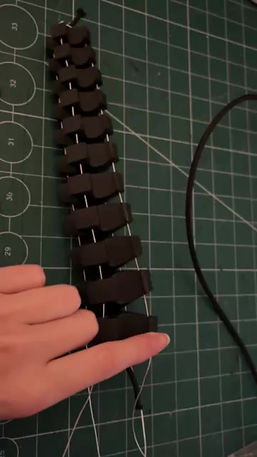
For this test, I paired the wires up diagonally to try and get a better range of movement. This worked well even when I was only using one servo motor and one pair of wires.

I then added the second servo motor and this increased the movement even more. As the servo motor only rotates 180°, the amount the tentacle could curve was limited. Changing to a 360° servo or a stepper motor would increase the motion significantly.

I experimented with three different 360° motors. The stepper motor i used for the syringe pump was too big and heavy. I tried the smaller stepper motor, initially with the same driver as the large stepper. I experimented with the wiring to get the motor to turn both clockwise and anticlockwise, however I could only get the motor to turn in one direction at a time. I then tested another driver that gave the option to turn in both directions. This worked well, but I discovered the problem with stepper motors is that they can't sense what position they are in. This would be problematic because the chain could be turned too far one way and fall off. I switched to testing a servo motor as servos can detect their position and turn to a specific angle, however I discovered that 360° servos cannot detect angles in the same way as 180° servos so it wasn't very accurate and would not solve the issue of position detection.

As these tentacles are more aesthetic than 'function', I decided that I could achieve enough movement from original 180° servo motors. I redesigned the chain attachment to fit the chain better. I also expanded it so that there was more surface area for the chain to move around; this allowed me to increase the range of mobility slightly. I showed the tentacle in the testbed and I was happy with the moment I could achieve from the design. People commented that it had a 'life-like' quality and that the movement was 'creepy' and 'eerie' which is exactly what I wanted. This also allowed me to test two different version of the chain attachment and identify issues with the design. Keeping the tension is very important as the chain could easily slip. The motors and at least the first 'vertebra' would need to be secured down to prevent them from moving so this is something I would need to consider in the body and internal mechanical design

I redesigned the tentacle to be smaller and more angled to increase the agility. When I put the first one together, it didn’t seem to move as well as the previous iterations. I realised I hadn’t put the elastic down the middle. Once I added this it became more movable and the elastic pulled it back into shape when it had been bent. Even small changes to the design could have such a big difference; this was something that was hard to control when making and designing as I had very little understanding of how things worked.

I made a skin out of silicone to cover the tentacle. I was worried that this would affect the movement, but it didn’t seem to make much difference at this stage. I also made two more versions of the chain attachment and picked the best of the two. It didn’t actually make much difference which one I picked, but I chose the one that the balls stuck to the most as this would reduce slipping.

I tested putting one tentacle into the body. I had to redesign the attachment method as I couldn't get the screws in due to the angle of the inside. It seemed to work really well and the raised height made the movement even more pronounced. I imagined that having the four moving at once would looked really creepy.

I used a motion simulator to develop the code for the motors. I wanted them to move differently to get a more natural effect. I also discovered a new smoothing function in the simulator that I implemented into my code. I wanted to create a slower, creepy movement, that looked more natural than robotic. Using the simulator was a good way to see how the changes affected the motors rather than just writing code blind. I then uploaded the best looking ones to the motors to fine tune.

When I tried putting all of the tentacles in with two wires per motor, the motors stalled and didn't move. If I removed one wire the motors would move, but it was still very unreliable. I changed the code to remove the smoothing function and make the movement stronger. This worked but I still couldn't have two wires per motor and I didn't like how the movement looked. I realised that it was the skin that was making the tentacles two heavy, combined with the cross angle of the wires making the torque too weak.

After a lot of experimenting with the code and how I attached the wires, I eventually decided to change the motors to stronger servo motors. I had to redesign the servo stand and horns which raised the wire attachment up, increasing the angle. This fixed the movement issues, but it created more problems. The wires snapped and the clamp didn't hold. I replaced all the wires for fresh ones and added a ball attachment to make the tightening process easier. I also added screws to the wall of the body to secure the tentacles in place.

I added all the tentacles and I was able to get a good degree of movement with the new motors. I didn't attach the wires in the cross angle in the end as I was concerned about the wires snapping and didn't have time to conduct more testing at this point. It was important to get the tension right on the wires so I spent a lot of time refining this to prevent them from falling off.
I put the skin on and was testing how things moved all together and I noticed one of the wires had snapped again. I replaced this wire, but then another couple snapped. I think the increased force combined with the increased angle was making them weak as they rubbed against the body. I changed the wires again, but eventually had to change to a threaded wire which was stiffer, but stronger.

I was happy with how the final monster looked. I would have liked to have refined how the movement worked and had more variety in the movement of each tentacle, but I didn't have time to experiment too much and I was worried I would break the tentacles in the process. I think that I achieved the desired effect from what I did implement though.

I put the monster on a mannequin, I was scared about breaking it so I was very cautious about turning it on. I was worried about it falling apart so I tightened the tube attachment; this restricted the airflow to some tentacles. I probably could have loosened these but I didn't want them to break. When I tried it on a person, they moved and knocked one of the tentacles off, this tore the skin. I was then really cautious about putting it on a person and turning it on.
The overall effect of having it on a body form was really impactful and it felt very imposing. The model also described it as very weird and disconcerting to wear which is exactly how I wanted it to feel.